
The castles of the valley
More than a hundred towers and manors, over a hundred kilometres of road.
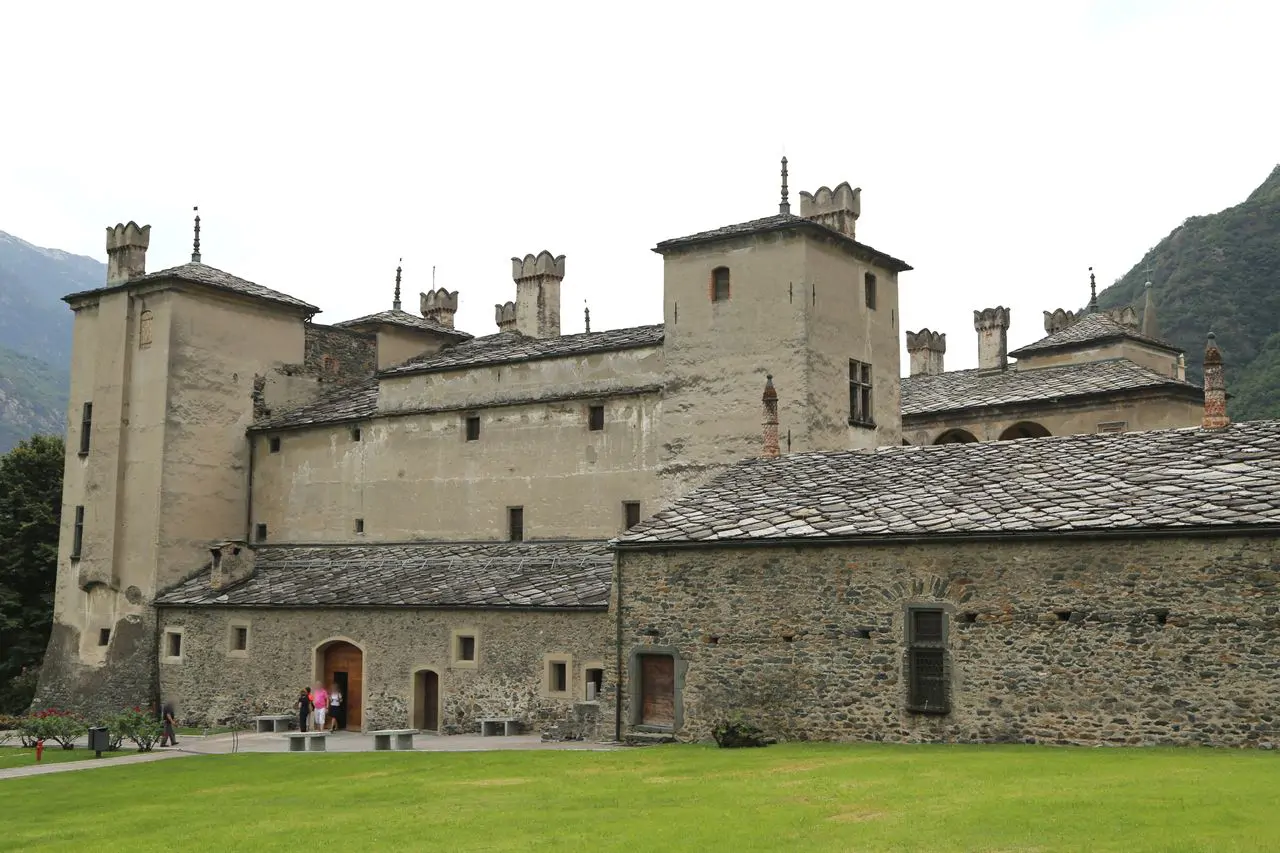
For centuries the main valley was the obligatory route between the Po plain and the alpine passes, and whoever controlled it collected the tolls. Hence the number of castles: more than a hundred fortresses, strong houses and towers, nearly all on a spur overlooking the road, and many visible from the motorway without stopping.
The most photographed is Fenis, built by the Challant family in the fourteenth century with a double ring of crenellated walls and an inner courtyard with a spiral stair and International Gothic frescoes. It was not a defensive fortress but a residence built to impress, and you can tell by looking at it.
Issogne and the others
Issogne, not far away, is fifteenth century and looks more like a palace than a castle: in the courtyard is the pomegranate fountain, a tree of wrought iron, and under the portico a series of frescoes portraying the shops of the day, the baker, the tailor, the fishmonger. Verres, by contrast, is a cube of stone thirty metres on a side, without ornament, and it really was meant for defence.
Sarre and the fort of Bard
Sarre was bought by Victor Emmanuel II in 1869 as a hunting base, and its rooms are decorated with thousands of ibex and chamois horns: it is a piece of nineteenth century history rather than of the Middle Ages. The fort of Bard closes the valley at its lower end: what you see today was rebuilt by the Savoys between 1830 and 1838, after Napoleon had it demolished, and it now houses the Museum of the Alps.
They are visited on separate tickets and their opening hours change with the season; Fenis, Issogne and Verres lie within twenty kilometres of each other and make one day, with Bard in the middle or at the end.